
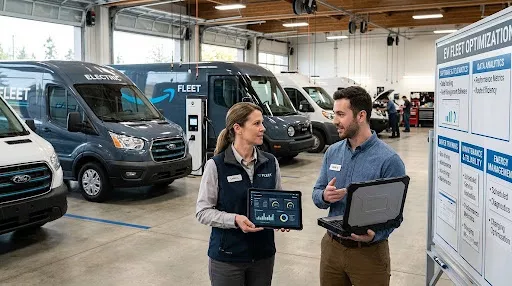
Forget the plug. Successful EV fleet management requires you to control route data, duty cycles, driver habits, and energy costs. You bought the trucks. You installed chargers. Do not stop there. The real work starts when the rubber hits the road.
Effective EV fleet management treats electrification as a daily operating model rather than a vehicle purchase. Track how your trucks move and where they park. Monitor how much energy they burn. Know what happens when a schedule slips.
Pull raw duty cycle data. Gather hard numbers on actual routes, daily mileage, payloads, and parking before buying anything. A glossy brochure is not a route plan. Bad weather, terrain, heavy traffic, and poor charging access gut vehicle performance.
Ask which truck completes your job reliably at the lowest operating cost. Match the asset to the mission.
The purchase price hides the true financial reality of your operation. A reliable business case must include financing, electricity, utility upgrades, and hardware. Account for insurance, tire wear, battery health, and unexpected downtime.
Build your financial model around cost per mile and vehicle utilization. A slightly more expensive truck that runs more shifts produces a stronger financial return.
Always use conservative estimates. Treat incentives as a lucky bonus. Your business model must survive if electricity rates spike or utilization drops. Protect your margins.
Design your charging grid backward from strict fleet schedules. Start your math with departure times, parking durations, and daily energy demand. Map out the available electrical capacity. Factor in future fleet growth.
Installing more chargers is dangerous. If ten dead trucks arrive and charge immediately, your depot pulls massive grid power. Use smart software to stagger charging sessions based on departure priority. Give power to the earliest routes first.
Match the charging speed to the mission. Plan schedules and infrastructure together.
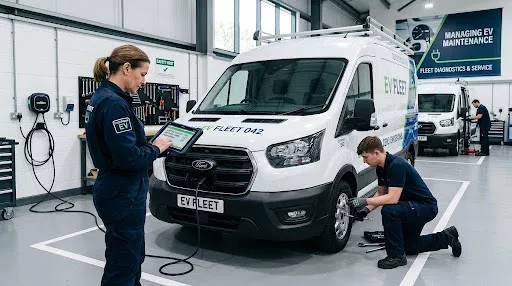
Telematics software gives you the raw operating data required to control your assets. Monitor live state of charge, battery health, and energy consumption. Track location, charging sessions, and specific fault codes.
This visibility alters daily dispatch decisions. Dispatchers instantly avoid assigning low-charge trucks to long routes. Managers hunt down inefficient vehicles eating profits. Maintenance teams investigate strange fault patterns before total failure occurs.
Turn raw data into rapid decisions. Speed wins.
Electric routes demand hard energy planning built directly into daily dispatch. Match specific trucks to routes using real-world range data and payloads. Factor in traffic conditions and mandate a sensible reserve.
Keep your route assignments highly predictable. Predictability makes schedules manageable and eliminates emergency top-ups. Track missed departures constantly. Monitor charging delays, excessive energy consumption, and unplanned stops.
Masterful EV fleet management works best when route data and battery data live in one system. Connect the dots.
Drivers directly dictate your efficiency, remaining range, and overall vehicle condition. Force them to master efficient acceleration and regenerative braking. Teach strict charging procedures and connector care. They must know how to react to battery warnings.
Technicians require a different skill set. They must learn complex high-voltage safety procedures and diagnostic systems. They need deep knowledge of strict manufacturer requirements.
Bake this training into standard onboarding. Refresh the curriculum when software changes. Ignorance destroys fleets.
Electric trucks are definitely not maintenance-free. Heavy tires, brakes, suspension systems, and cooling systems require constant attention. Battery data and software updates add a new layer of work.
Create strict preventive maintenance intervals using actual fleet data and manufacturer guidelines. Keep critical charging hardware covered by a rapid response plan. A dead charger sidelines multiple trucks instantly.
Measure vehicle uptime as a core business metric. Do not treat it as a shop metric.
A ruthless operating scorecard exposes tiny problems before they become massive financial disasters. Track these distinct items relentlessly:
Review these harsh numbers by specific vehicle and route. High fleet averages easily hide repeated failures and poorly planned routes. Expose the truth.
Scale your operations in highly controlled stages. Start with simple predictable routes, guaranteed parking, and reliable charging access. Ensure high utilization to quickly test your economics. Run a strict pilot, document every failure, adjust procedures, and expand.
Do not scale your hardware faster than your operating model. Adding trucks without enough electrical power multiplies your problems.
A scalable EV fleet management system assigns clear ownership across facilities, finance, IT, and maintenance. Define exactly who owns charger uptime. Demand accountability.
Stop leaving cash on the table. A successful electric fleet depends entirely on disciplined daily operations happening behind the vehicles. Connect your deployment, charging strategy, and operational planning to guarantee reliable business outcomes. Demand perfection. Contact Fairway EV to build a profitable, resilient, and highly efficient electric operation today.
No. Proper EV fleet management requires you to relentlessly control vehicle selection, daily routing, strict maintenance, driver training, and hard financial performance across your entire operation.
You must compare actual daily mileage, heavy payloads, expected traffic, tough terrain, harsh weather, and charging access against verified real-world vehicle performance before assigning routes.
No. Your charger speed must directly match duty cycles, parking dwell times, grid capacity, and firm departure requirements to prevent massive utility bills and protect batteries.
You must relentlessly track total utilization, precise energy consumption, charger downtime, route completion rates, and strict cost per mile to identify operational gaps early and consistently.
Expand only after a strict pilot demonstrates reliable route completion, strong charging availability, low operating costs, fully trained staff, and a repeatable process for handling failures.
Diversity Supplier Participant


© Fairway EV. All rights reserved


