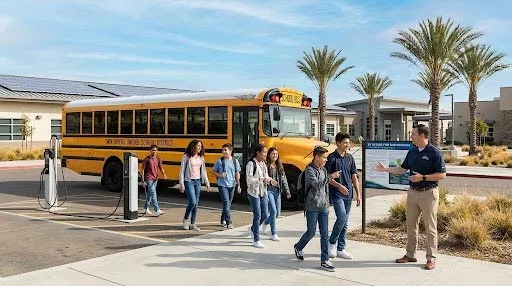
You don’t really need a big five-year strategic plan just to electrify your fleet. You just need to copy what already works for other people. Twin Rivers Unified School District, a mid-size operation just northeast of Sacramento, spent eight years turning a bunch of skepticism into the largest zero emission school bus fleet across North America.
The reality is that California isn't asking districts if they want fleet electrification anymore. The state's zero-emission mandates for medium- and heavy-duty vehicles are coming whether your board budgeted for it or not. Twin Rivers didn't wait for a perfect mandate. They started in 2016 with 16 buses and a transportation director who, by his own admission, wasn't sold on the math yet.
Numbers kind of tell it, better than adjectives ever could. Twin Rivers serves approximately 25,000 students across 52 school sites, spread over 82 square miles of Sacramento County. So, it is not one of those neat little urban districts with quick routes and easy, forgiving grades. No, it is more sprawly, suburban, and honestly it is the exact kind of landscape critics point to when they say electric school buses can not manage real world routes.
They handled it anyway.
By 2020, the fleet had grown from 16 buses to 40. By 2023, it had climbed past 70. The district's director of transportation admitted the emissions math was obvious from day one, but the return on investment took years to prove out. That's rare to hear out loud. Most case studies skip that part entirely.
Because Twin Rivers ended up stacking pretty much every funding source they could track down, instead of putting the entire project on a single grant. When they added 10 more buses in 2020, the money arrived from at least three different pots like California Air Resources Board community air protection dollars, HVIP vouchers, and the local matching funds too.
| Funding Source | What It Covered | Approximate Contribution |
|---|---|---|
| CARB Community Air Protection Incentives | Offsetting bus purchase price | $100,000 |
| HVIP (Hybrid & Zero-Emission Voucher Incentive) | Offsetting bus purchase price | $220,000 |
| Local & state matching funds | Remaining cost of 10 buses | Balance of $4M+ total |
| Charging infrastructure funding (cumulative) | Depot upgrades, panels, chargers | $4.5 million+ |
Look at it this way: if your district is waiting on a single grant application to fund an entire electric school bus purchase, you're already behind. Twin Rivers treated funding like a portfolio, not a lottery ticket.
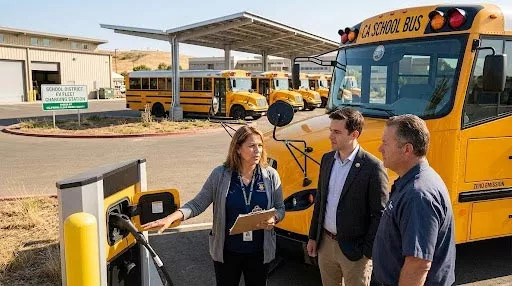
The bus purchase was only half the equation, though. Charging infrastructure ate more than $4.5 million on its own, a number that rarely makes the press release photos. Buses are the easy part now. Panel capacity, transformer upgrades, depot retrofits? That's where budgets quietly die.
Sacramento Municipal Utility District turned out to be the unsung partner in all of this. They worked with Twin Rivers on off-peak charging rates, so the buses charge overnight when the power is cheaper and the grid is not really crowded or stressed, basically. Also, the district put together a vehicle-to-grid solar setup beside its transportation facility, it helps as a backup for power during outages, and it also moves extra electricity back into the grid to be sold. Not bad for a school bus depot.
Range, mostly. Early buses peaked around 125 miles, which sounds ok until you plot it next to actual suburban routes with a bunch of stops, traffic, and hills that pull energy out of a battery faster than a flat road does.
It was charging infrastructure that was the real choke point, not the buses themselves. Depots built for diesel trucks don't automatically have the electrical capacity to charge a dozen buses at once overnight. Twin Rivers got lucky. They already had power capacity at their facility, plus a utility partner willing to work through the rest.
Worse still, there's a workforce problem nobody puts on a slide deck. High-voltage battery systems aren't something a diesel mechanic picks up by osmosis. Twin Rivers built an actual workforce development plan into its electrification blueprint, identifying local training partners and building a technician pipeline instead of hoping qualified people would show up on their own. Most districts skip this step. Then they wonder why buses sit in the shop for weeks.
California's Advanced Clean Fleets rule and the 2045 target for zero-emission medium- and heavy-duty vehicles aren't hypothetical anymore. They're deadlines. And deadlines have a way of turning "someday" into "this fiscal year" pretty fast.
Twin Rivers isn't the only district feeling that pressure, and it isn't the only one responding to it. Porterville Unified is building a solar-plus-storage microgrid to power dozens of fast chargers for its own bus fleet. Madera Unified and Thermalito Union have their own electrification pushes underway too. None of them are copying Twin Rivers exactly, but all of them point to it when asking their boards for money. That's what a proof of concept is for.
None of these are complicated. They're just easy to skip when a sales rep is standing in front of your board with a glossy brochure and no mention of your electrical panel.
None of this works if your charging infrastructure can't keep up or your maintenance plan falls apart six months after the ribbon cutting. Get your depot's electrical capacity assessed before you sign a single purchase order, not after the buses show up and sit uncharged in the lot.
Fairway EV works with California school districts and municipal fleets on exactly this problem, from campus utility vehicle electrification to keeping mixed EV and diesel fleets running without downtime. Start with an infrastructure conversation, not a vehicle catalog.
Twin Rivers took roughly seven years to go from 16 buses to over 70. Plan in phases, not one giant purchase order.
Charging infrastructure, not the buses themselves. Panel upgrades, transformers, and depot retrofits routinely cost millions before a bus plugs in.
Usually, yes. Lower fuel and maintenance costs plus LCFS credit revenue tend to offset the higher upfront price over time.
HVIP vouchers, CARB Community Air Protection Incentives, and local air district matching funds are the main three. Most districts stack all of them.
Rarely. Most depots need panel and transformer upgrades before they can charge multiple buses overnight without tripping the system.
Diversity Supplier Participant


© Fairway EV. All rights reserved


